




How to Solve Heavy Metal Complex Destruction in Electroplating Wastewater Using Ozone
If you run a plating facility or design industrial wastewater treatment systems, you already know the hardest bottleneck in effluent compliance: heavy metal complexes.
Traditional lime precipitation or standard hydroxide precipitation works well for free metal ions. However, when complexing agents like EDTA, citric acid, or cyanide bond tightly with metals such as copper (Cu), nickel (Ni), and zinc (Zn), standard pH adjustment fails completely. The metals remain locked in solution, causing your discharge to fail heavy metal limits.
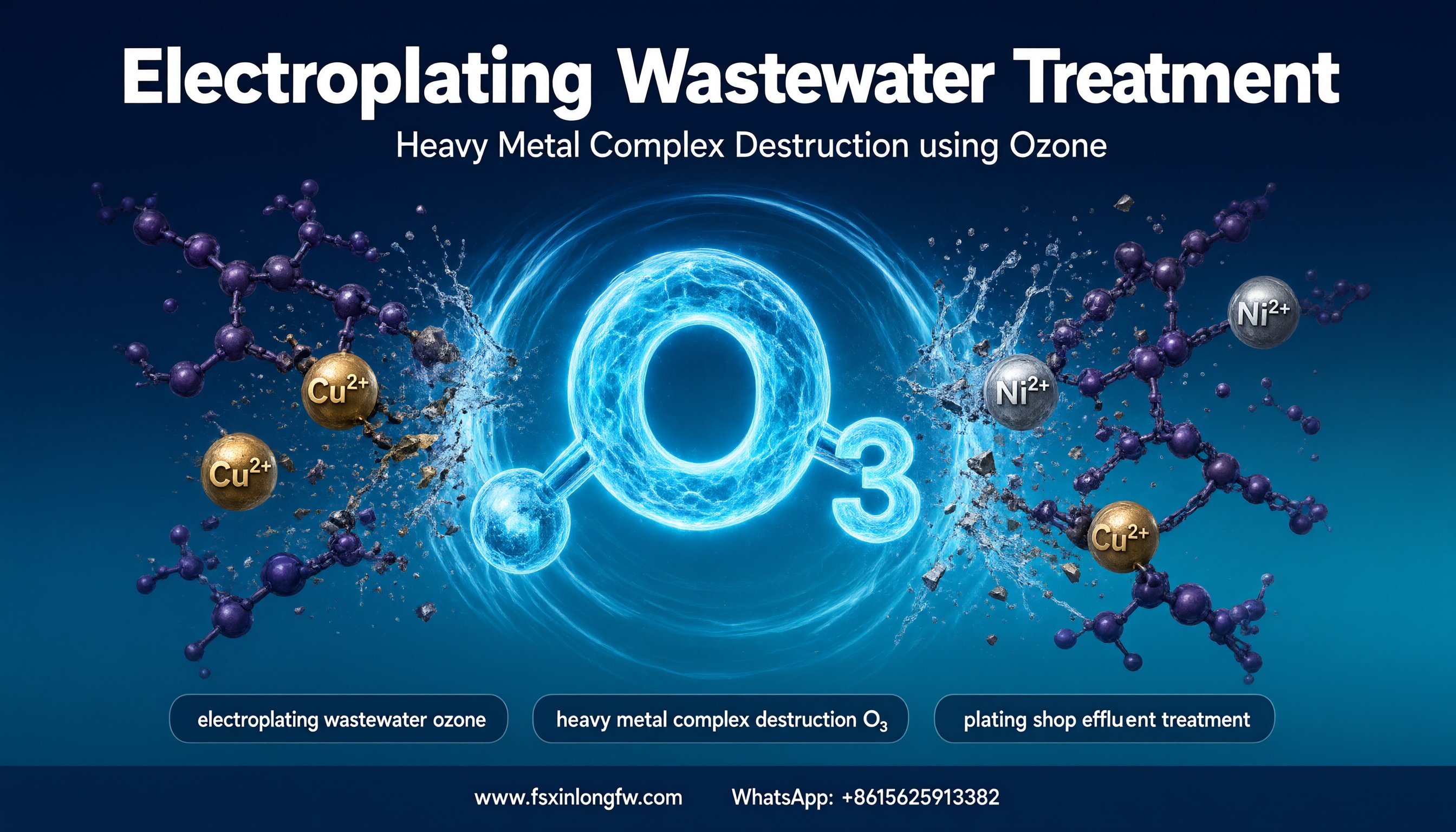
In this technical guide, we examine how electroplating wastewater ozone treatment—specifically heavy metal complex destruction using O3—provides a robust, chemical-free oxidation solution for modern plating shop effluent treatment.
The Root Problem: Why Conventional Precipitation Fails
In modern electroplating and surface finishing lines, complexing agents are widely used in electrodeless plating, cleaning, and etching baths to stabilize metal ions.
- The Mechanism of Interference: These chelating agents wrap around metal ions, forming stable soluble complexes. Because the chemical bond between the organic ligand and the metal ion is exceptionally strong, traditional coagulants (like polyaluminum chloride) and alkalis (like sodium hydroxide or lime) cannot break the bond to form insoluble metal hydroxides.
- The Regulatory Risk: Residual copper or nickel escaping into municipal sewage systems leads to severe environmental fines, mandatory production halts, or failed audits.
While traditional oxidation methods—such as breakpoint chlorination or Fenton’s reagent—can break some complexes, they introduce secondary pollutants (chlorinated organics, high total dissolved solids, or massive sludge volumes). This is why process engineers increasingly turn to ozone gas (O3).
How Ozone Breaks Heavy Metal Complexes (O3 Destruction Mechanism)
Ozone is one of the most powerful commercially available oxidizing agents. When introduced into electroplating wastewater, it attacks complexed heavy metals through two primary pathways:
- Direct Molecular Ozone Oxidation: O3 molecules directly attack the electron-rich sites of organic chelating agents (such as EDTA or organic acids), cleaving the molecular backbone.
- Hydroxyl Radical (•OH) Generation (Advanced Oxidation): In slightly alkaline conditions or when coupled with catalysts/UV, ozone decomposes into highly reactive hydroxyl radicals. These radicals non-selectively mineralize the organic ligands.
Once the organic ligand is destroyed, the metal ion is released from its cage-like structure into a free ionic state (Cu^2+, Ni^2+).
[Metal-Chelate Complex]+ O3 →Free Metal Ion (M^2+) + Degraded Organics + CO2 + H2O
Immediately following this destruction phase, standard alkali adjustment precipitates the newly freed metal ions into filterable hydroxide flocs:
M^2+ + 2OH^- →M(OH)2 ↓
Key Advantages for Industrial Plating Facilities
Integrating an industrial ozone generator into your wastewater treatment train offers distinct operational advantages over traditional chemical breakdown:
- No Secondary Sludge or Chemical Residue: Unlike chlorine-based treatments that increase salinity or coagulants that bloat sludge disposal costs, ozone naturally reverts back to oxygen (O2), leaving zero chemical residues in the water.
- Effective Across Complex Streams: Highly efficient at breaking down stubborn nickel-EDTA, copper-pyrophosphate, and cyanide complexes that survive biological and standard chemical treatments.
- Automated & Continuous Integration: Modern skid-mounted ozone systems integrate seamlessly with existing equalization tanks, pH controllers, and gas-liquid mixing pumps (venturi injectors) for fully automated, inline operation.
System Design Considerations for Engineers
When sizing an ozone system for plating effluent treatment, engineers should evaluate:
- COD / TOC Load: High background chemical oxygen demand will consume ozone before it attacks the metal complexes. Pre-oxidation or equalization is often necessary.
- pH Optimization: Ozone stability and radical formation rates vary significantly with pH. Adjusting wastewater to the optimal pH range ensures maximum oxidation efficiency with minimal ozone wastage.
- Gas-Liquid Mass Transfer: Because ozone has limited solubility, high-efficiency mixing systems (such as pressurized venturi injectors and reaction columns) are mandatory to ensure complete gas dissolution.
Upgrade Your Wastewater Treatment Plant Today
Meeting zero-discharge and strict environmental regulations requires reliable, high-efficiency oxidation technology. Whether you are upgrading an existing electroplating effluent plant or engineering a brand-new facility, our robust industrial ozone generator systems are built to handle rigorous continuous-duty industrial applications.
- Explore Our Industrial Ozone Generators & Custom Skid Systems
- Contact Our Team for Custom Flow-Rate Sizing & Quotations
Tags:
Related Posts