




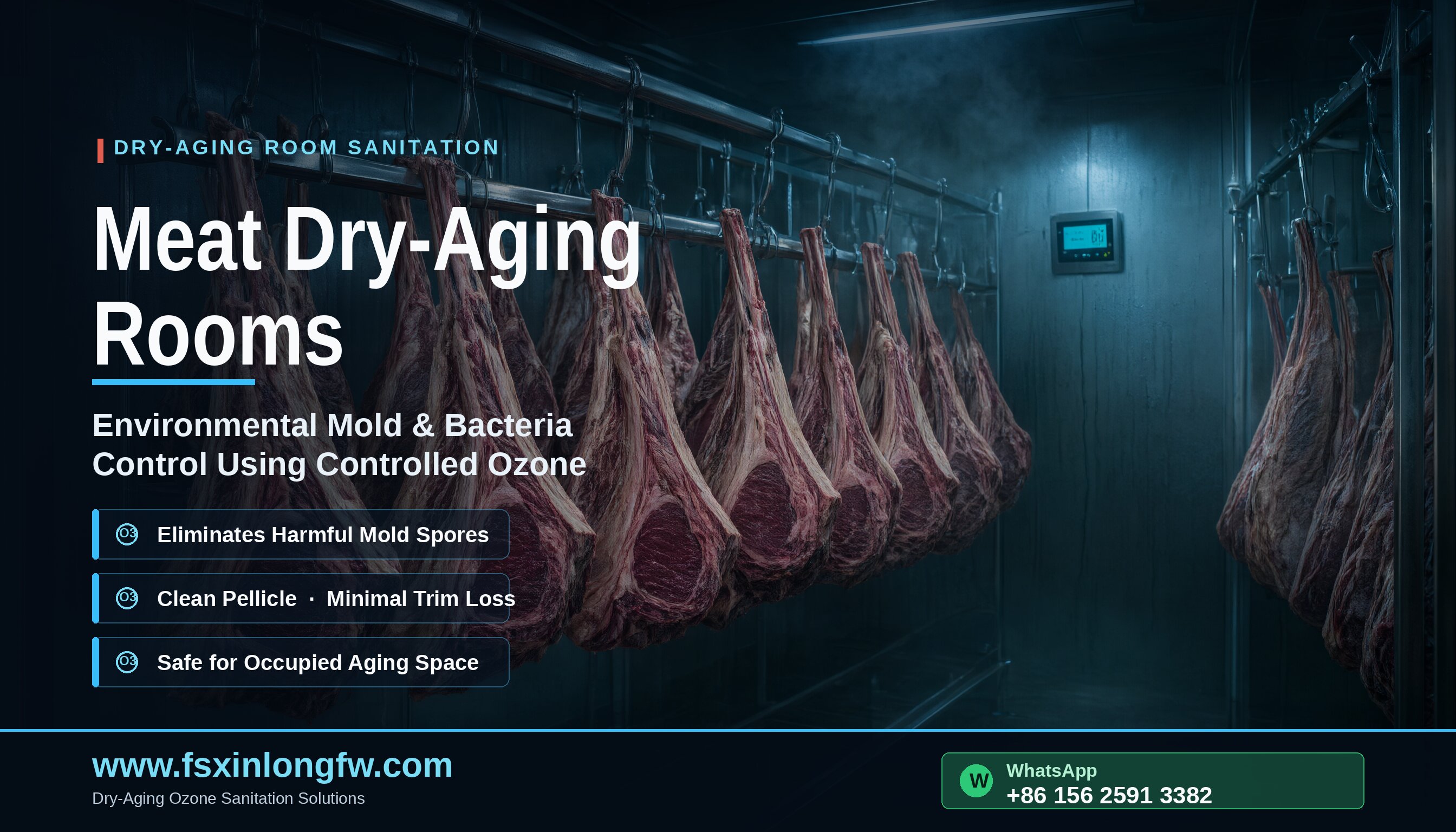
Meat Dry-Aging Rooms: How Controlled Ozone Stops Bad Mold & Spoilage
Meat Dry-Aging Rooms: How Controlled Ozone Stops Bad Mold & Spoilage
Walking into a dry-aging cooler that smells like sour yeast or musty basement air is a butcher's worst nightmare. When you are hanging $20-per-pound primal cuts for 30 to 90 days at 80%–85% relative humidity, the line between crafting a nutty, tender delicacy and losing thousands of dollars to surface spoilage is razor-thin.
Traditional sanitation methods—like chemical sprays or UV-C lamps—fall short inside a fully loaded aging chamber. Chemicals leave residues and alter flavor profiles, while UV light only sanitizes direct line-of-sight surfaces, missing the damp corners behind racks and inside evaporator coils.
This is why commercial steakhouses, craft butcheries, and charcuterie producers are turning to meat dry aging ozone systems. Unlike harsh chemical fogging, low-level gaseous ozone circulates continuously through cold storage air, keeping spoilage bacteria and unwanted mold spores in check without touching the meat's natural enzymatic breakdown.
The Microbial Tightrope in Beef Dry-Aging
Successful dry-aging relies on three tightly controlled variables: temperature (1°C to 3°C / 34°F to 38°F), airflow, and high relative humidity (80% to 85%).
Unfortunately, those exact conditions create an ideal incubator for airborne pathogens and invasive fungi. While certain beneficial molds (like Thamnidium) contribute to tenderness and flavor, uncontrolled rooms quickly get overrun by:
- Spoilage Bacteria (Pseudomonas spp.): Causes surface slime, off-odors, and rapid discoloration, forcing heavy trimming loss.
- Invasive Molds (Penicillium, Aspergillus, Cladosporium): Produces fuzzy green, black, or white colonies that penetrate deep into fat caps and cross-contaminate fresh batches.
- Airborne Cross-Contamination: Every time staff open the cooler door, outside spores enter and settle on cooling fans, walls, and stainless steel racks.
When bad mold takes hold, processors lose 15% to 25% of their yield just to aggressive bark trimming—or worse, discard entire primals.
How Controlled Ozone Works in Cold Storage
Effective beef aging room mold control isn't about blasting the room with high-dose gas; it is about maintaining a steady, micro-dosed oxidation barrier in the air.
Ozone (O3) is a triatomic oxygen molecule that naturally seeks out and oxidizes organic contaminants. In a dry-aging environment, a commercial ozone generator delivers precise, low concentrations (typically 0.03 to 0.08 ppm during active aging) directly into the room's airflow.
- Neutralizes Airborne Spores: Before mold spores can land on fresh beef or salami casings, ozone ruptures their cell walls, stopping colonization at the source.
- Reaches Hidden Blind Spots: Because ozone is a gas, it penetrates behind meat racks, under shelving, and inside refrigeration evaporator fins where manual wiping never reaches.
- Eliminates Cross-Odors: Ozone breaks down volatile organic compounds (VOCs) and stale air, keeping the chamber smelling clean without masking odors with artificial scents.
- Leaves Zero Chemical Residue: After oxidizing bacteria or mold spores, O3 reverts cleanly back into pure oxygen (O2) within 20 to 30 minutes—leaving zero chemical trace on the meat crust.
Important Note on Fat Oxidation: Too much ozone in a meat cooler will oxidize surface lipids, causing rancidity or premature graying of the beef fat. That is why precision control—not raw high output—is critical for meat applications.
Ozone vs. Traditional Aging Room Sanitation
| Sanitation Method | Reaches Hidden Corners? | Chemical Residue? | Safe Around Active Meat? | Impact on Yield & Trim Loss |
| Controlled Ozone (O3) | Yes (gaseous circulation) | None (reverts to O2) | Yes (at 0.03–0.08 ppm) | Reduces trim loss by preventing deep mold |
| UV-C Lights | No (line-of-sight only) | None | Partial (can accelerate fat oxidation up close) | Limited to exposed air ducts |
| Chemical Sprays / Fogging | Partial | Yes (requires washdown) | No (must empty room first) | High labor downtime between batches |
| HEPA Filtration Alone | No (only treats air passing through filter) | None | Yes | Does not kill mold growing on walls or coils |
Best Practices for Meat & Charcuterie Ozone Disinfection
Whether you are running a boutique steakhouse aging cabinet or a multi-ton charcuterie ozone disinfection facility, sizing and concentration control determine your results:
- During Active Aging (Occupied Room): Run an air-fed or oxygen-fed commercial ozone generator paired with an electrochemical O3 sensor. Maintain levels strictly between 0.03 and 0.08 ppm—enough to suppress Pseudomonas and surface mold growth without oxidizing beef fat or inhibiting desirable fermentation flora in cured sausages.
- Between Batches (Empty Room Shock Treatment): When rotating inventory, run a higher shock cycle (1.0 to 3.0 ppm for 1–2 hours with no staff inside) to sanitize walls, ceiling fans, and wooden or steel racks before loading new primals.
- Protect Equipment Materials: Cold, humid rooms accelerate corrosion. Choose an industrial unit built with a stainless steel housing and PTFE (Teflon) tubing rather than painted mild steel or standard rubber hoses.
- Account for Low Temperature & High Humidity: Standard ozone generators lose up to 40% efficiency in 85% humidity. Look for systems equipped with built-in air dryers or corona discharge tubes engineered for high-moisture cold storage.
Ready to Reduce Trim Loss in Your Aging Room?
Every dry-aging chamber has different airflow dynamics, meat load capacities, and humidity swings. Off-the-shelf plug-in ozonizers rarely offer the concentration accuracy needed to protect high-value beef without risking fat oxidation.
At Xinlong, we supply stainless steel commercial and industrial ozone generators engineered for cold storage, meat processing plants, and food sanitation facilities—complete with timer controls, external ozone monitoring compatibility, and moisture-resistant corona discharge technology.
- Explore Our Systems: Browse our Industrial Ozone Generators for Food Processing to compare air-fed and oxygen-fed units.
- Get a Custom Sizing Recommendation: Tell us your aging room dimensions (L x W x H), operating temperature, and humidity level. Contact our engineering sales team today for a tailored ozone setup and quote.
Tags:
Related Posts