




Ozone Concentration (g/m³) vs. Yield (g/h): Buyer’s Guide
Concentration (g/m³) vs. Yield (g/h): How to Calculate Industrial Ozone Generator Capacity
When comparing industrial ozone generators, looking only at the "grams per hour" rating on a spec sheet is one of the fastest ways to buy the wrong machine.
Many procurement managers request a "100 g/h ozone system," receive three quotes at wildly different price points, and naturally lean toward the cheapest option. Six months later, their wastewater COD levels haven't dropped, or their bottling line fails a microbial test. Why? Because two generators can both produce 100 g/h of ozone while performing completely differently in the field.
To source the right equipment, you need to understand the relationship between ozone concentration (g/m³), ozone yield (g/h), and gas flow rate (L/min or m³/h). Here is how to read a technical spec sheet like an engineer and verify what you are actually paying for.
1. What is Ozone Yield (g/h)?
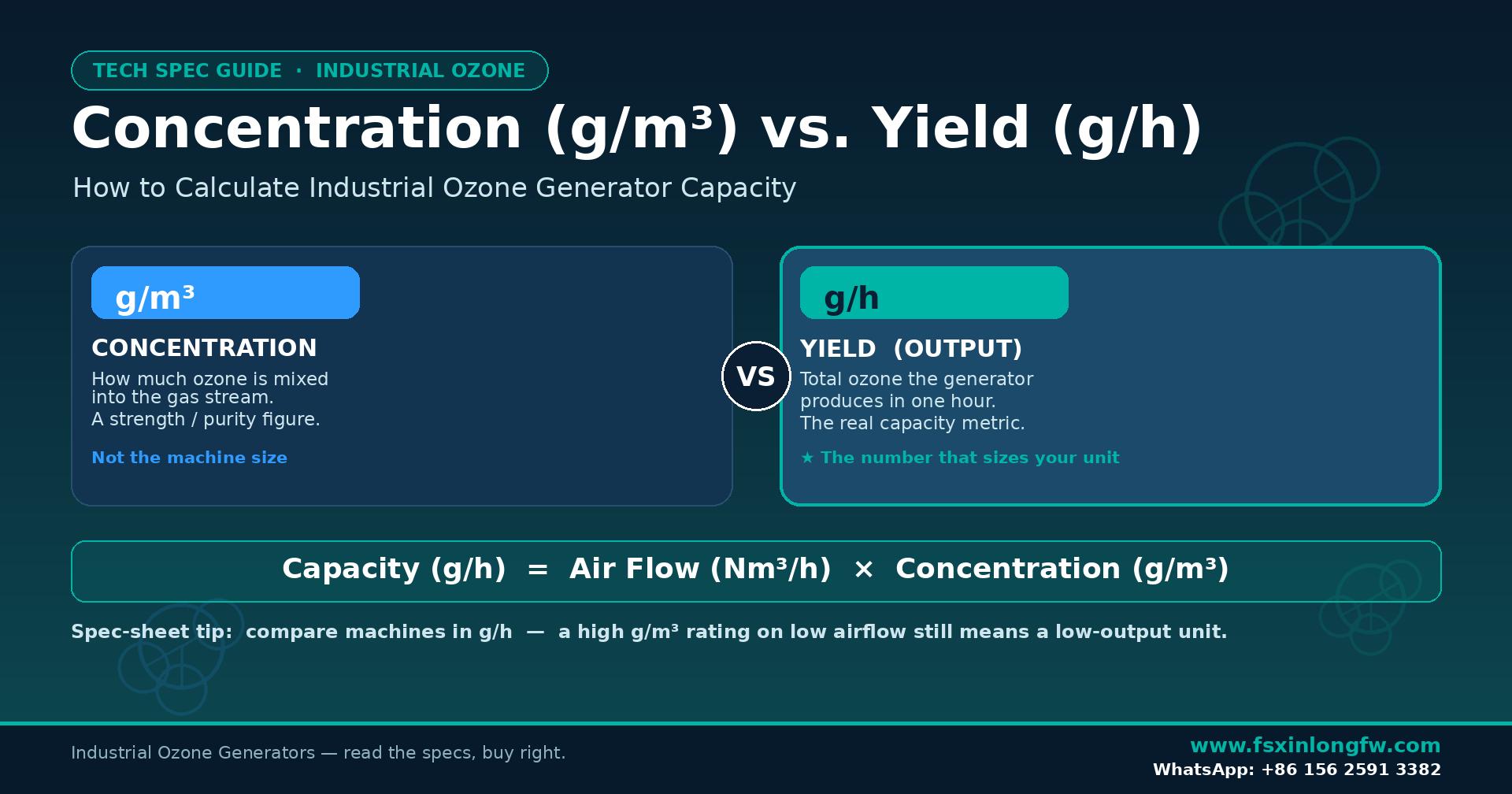
Ozone yield (or output) measures the total mass of ozone gas produced by the generator over one hour. It is typically expressed in grams per hour (g/h) or kilograms per hour (kg/h).
Think of yield as the total volume of water coming out of a pipe in an hour. It tells you the overall capacity of the machine, which helps determine whether the system is sized correctly for your total water volume or room size. However, yield alone tells you nothing about the strength or density of that ozone gas.
2. What is Ozone Concentration (g/m³)?
Ozone concentration measures how densely packed the ozone molecules are within the carrier gas (either dried air or pure oxygen). It is measured in grams per cubic meter (g/m³) or milligrams per liter (mg/L)—note that 1 g/m³ is equal to 1 mg/L.
If yield is the total amount of water, concentration is the water pressure. In industrial applications—especially water treatment, chemical oxidation, and aquaculture—concentration is arguably more critical than total yield.
Why Concentration Dictates Mass Transfer Efficiency
According to Henry’s Law, the rate at which a gas dissolves into a liquid is directly proportional to its partial pressure (concentration).
- Low Concentration (15–30 g/m³, typically air-fed): A large portion of the ozone bubbles will simply rise to the surface and off-gas into the atmosphere without dissolving into your water. You waste energy and need a massive ozone destruct unit.
- High Concentration (80–120+ g/m³, oxygen-fed): High-concentration ozone dissolves rapidly and achieves much higher dissolved ozone residuals, allowing you to treat stubborn pollutants with a smaller footprint.
3. The Core Formula: How to Calculate Ozone Output
These three parameters are locked together by a simple physical equation. Whenever a supplier sends you a quotation, you should always run this quick check:
Ozone Yield (g/h) = Concentration (g/m^3) x Gas Flow Rate (m^3/h)
(Note: If the spec sheet lists gas flow in Liters per Minute (L/min), multiply L/min by 0.06 to convert it to m³/h.)
Real-World Example: Spot the "Spec Sheet Trap"
Imagine two suppliers quote you a 100 g/h industrial ozone generator:
| Specification | Supplier A (Low-Cost Unit) | Supplier B (High-Efficiency Industrial Unit) |
| Feed Gas | Ambient Air (with basic dryer) | Concentrated Oxygen (PSA Oxygen Concentrator) |
| Gas Flow Rate | 5 m³/h (approx. 83 L/min) | 1 m³/h (approx. 16.7 L/min) |
| Ozone Concentration | 20 g/m³ | 100 g/m³ |
| Calculated Yield | 20 g/m³ × 5 m³/h = 100 g/h | 100 g/m³ × 1 m³/h = 100 g/h |
On paper, both machines produce 100 g/h. In practice, Supplier B’s machine delivers 5 times the gas concentration. If you are injecting this ozone into a pressurized water pipe via a Venturi injector, Supplier A’s high gas flow rate (83 L/min) will cause severe gas-lock and poor dissolution, whereas Supplier B’s concentrated stream (16.7 L/min) will dissolve cleanly and oxidize contaminants faster.
4. Which Specs Do You Need for Your Application?
Different industries require different balances between yield and concentration:
- Wastewater Treatment, Bottled Water & Food Sanitation: Prioritize high concentration (80–120 g/m³). You need an oxygen-fed corona discharge system to maximize mass transfer into water.
- Cold Storage, Odor Control & Air Disinfection: Moderate concentration (20–40 g/m³) with higher airflow is usually sufficient, because the ozone is dispersing directly into air rather than fighting water surface tension.
- Swimming Pools & Aquaculture: Aim for a balanced mid-to-high concentration (50–80 g/m³) to ensure safe, predictable ORP (Oxidation-Reduction Potential) levels without excessive off-gassing.
5. Three Questions to Ask Before Buying an Industrial Ozone System
Before signing off on a purchase order, verify these three details with your manufacturer:
- Is the yield rated using air or pure oxygen? Some suppliers test their machines using bottled 99.5% pure oxygen in a lab to advertise a high g/h number, even though the standard unit ships with an air pump.
- At what ambient temperature and humidity was the output tested? Corona discharge cells lose efficiency as temperatures rise. Make sure the rated output reflects continuous 24/7 industrial operation, not a 5-minute cold start.
- Does the flow meter match the math? If a supplier claims 200 g/h output at a flow rate of 15 L/min (0.9 m³/h), the concentration would have to be 222 g/m³—which exceeds the physical limits of standard commercial corona discharge tubes. Always check the math.
Need Help Sizing Your Industrial Ozone System?
Choosing between a 100 g/h, 200 g/h, or modular multi-unit setup shouldn't be a guessing game. At [Xinlong], our engineering team calculates your exact dosage requirements based on your water flow rate, target COD/BOD reduction, or room volume—and provides transparent, verified test data for both concentration and yield.
- Explore our high-concentration oxygen-fed models: View technical specs for our 100g/h Industrial Ozone Generator (SK-CFG-100C) and 200g/h Heavy-Duty Ozone System (SK-CFG-200D).
- Get a custom sizing calculation: Contact our technical team via WhatsApp or Email with your water/air parameters, and we will recommend the right configuration within 24 hours.
Tags:
Related Posts