




Off-Flavor Removal in Farmed Fish (Geosmin & MIB): How Ozone Oxidation Works in RAS & Depuration
Off-Flavor Removal in Farmed Fish (Geosmin & MIB): How Ozone Oxidation Works in RAS & Depuration
If you run a recirculating aquaculture system (RAS) or a fish processing plant, you already know how frustrating it is when healthy, fast-growing fish come back with an earthy, musty smell right before harvest. Buyers reject batches, retail prices drop, and your margin disappears—even when water quality looks fine on paper.
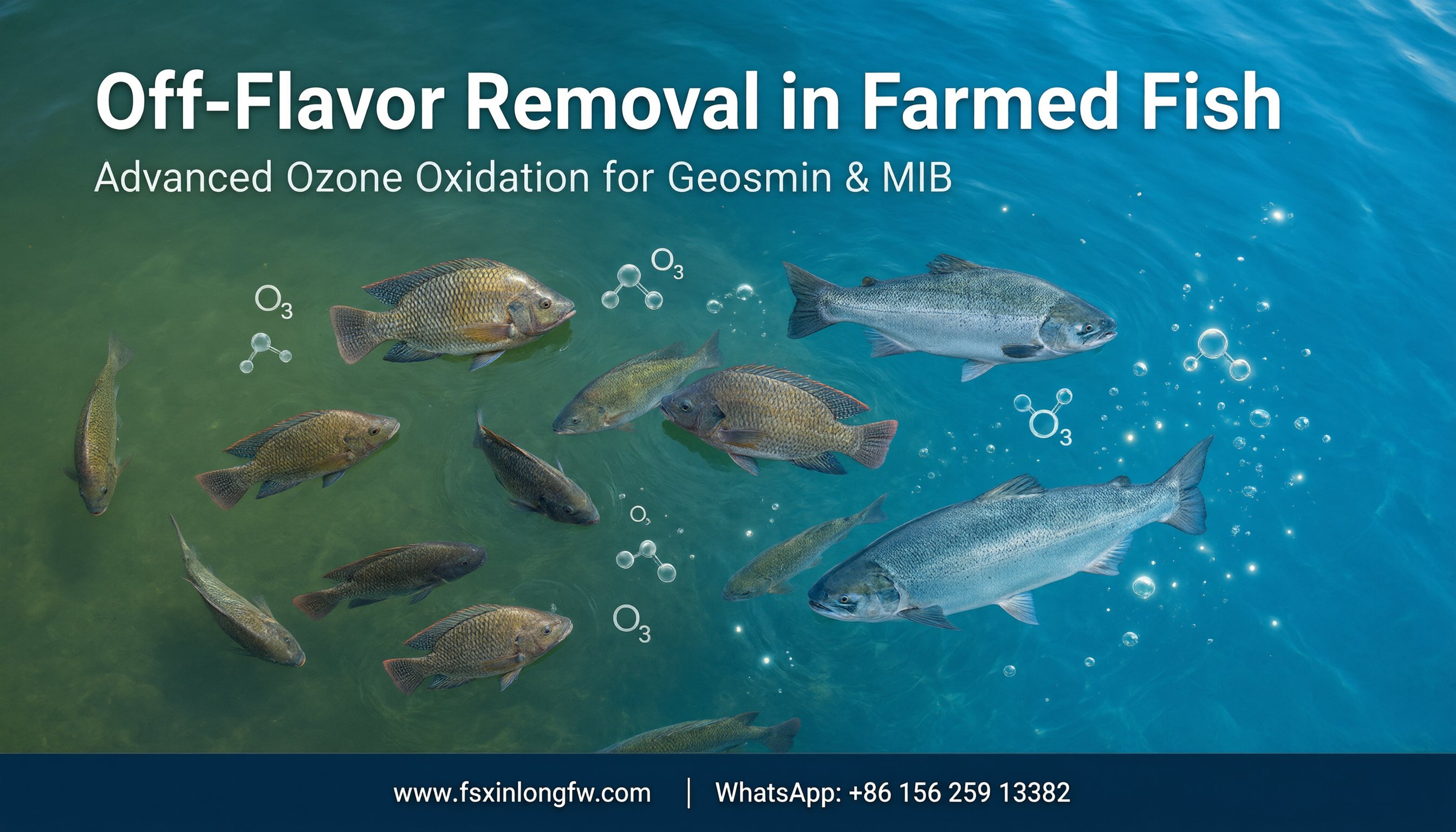
That "muddy" taste usually comes down to two trace compounds: geosmin and 2-methylisoborneol (MIB). Standard mechanical filtration and routine biofilters rarely strip them out fast enough once they build up in the system or accumulate in fish tissue. That is why many commercial farms and processors are turning to ozone oxidation—both inside RAS loops and in dedicated pre-harvest depuration (purging) tanks—to get clean, neutral-tasting fish to market.
Why Geosmin and MIB Are So Hard to Remove
Geosmin and MIB are produced mainly by actinomycetes and certain cyanobacteria thriving on organic solids,uneaten feed, and biofilm surfaces. Humans can detect geosmin at concentrations measured in just a few nanograms per liter (parts per trillion).
Two practical headaches make them stubborn in commercial fish production:
- Resistance to basic treatment: Neither compound settles easily, and conventional solids removal leaves dissolved organics behind that keep odor-producing microbes active.
- Tissue accumulation vs. clearance: Once geosmin and MIB enter the bloodstream and muscle tissue (especially fatty tissues in species like tilapia, trout, salmon, or catfish), fish only purge them as a concentration gradient forms between their flesh and cleaner surrounding water.
How Ozone Oxidation Tackles Off-Flavor in Aquaculture
When you apply ozone properly, it acts as a strong oxidizer—breaking down complex ring structures in geosmin and MIB molecules into smaller, non-odorous byproducts, while also oxidizing dissolved organic matter and reducing bacterial load in the water.
In real-world operations, off-flavor fish RAS ozone setups usually follow one of two approaches (or a combination of both):
1. Pre-Harvest Depuration / Holding Tanks ("Purging" Before Sale)
Many processors and large farms run dedicated holding or purging tanks for several days before shipping. Clean, low-geosmin water treated with controlled ozone helps lower background odor compounds in the tank while keeping water clear. Because the fish are held separately from the main production loop, you can fine-tune oxidation without disrupting your primary culture tanks.
2. Sidestream Treatment in Recirculating Aquaculture Systems (RAS)
In an RAS, ozonation is typically installed on a sidestream rather than blasting raw water straight into the fish tank. A sidestream gives you proper contact time, controlled mixing (via Venturi injectors, fine-bubble diffusers, or contact columns), and a safe off-gas destruction / degassing step before water returns to the biofilter or fish culture tank.
Important operational note: Ozone is a double-edged sword if overdosed. Excess dissolved ozone or residual oxidants can irritate fish gills or harm nitrifying bacteria in your biofilter. Reliable ORP (Oxidation-Reduction Potential) monitoring, proper degassing, and conservative sizing matter just as much as ozone output itself.
Key Sizing & System Factors for Commercial Farms and Processors
Because every farm's water chemistry, stocking density, and target throughput differ, choosing an industrial ozone system should start with clear operating numbers rather than guesswork:
- Target throughput & batch size: Are you treating a 20 m³ purging tank between harvests, or a continuous RAS flow of hundreds of cubic meters per hour?
- Water matrix & organic load: Higher COD/BOD, suspended solids, or color consumes ozone faster before it ever touches geosmin and MIB.
- Feed gas & ozone concentration: Air-fed generators work well for lighter duties or smaller setups, while oxygen-fed industrial ozone generators deliver higher ozone concentration and mass-transfer efficiency for larger RAS or processing plant demands.
- Safety & controls: Look for industrial-grade components, corrosion-resistant materials (stainless steel, PVDF/UPVC where appropriate), ORP/ozone control integration, and proper off-gas management.
If you are evaluating equipment for a specific project, explore our Industrial Ozone Generators or browse our Aquaculture & Water Treatment Applications to see how different capacities fit real plant layouts.
Practical Checklist Before You Request a Quote
To help size the right system quickly—and avoid over- or under-specifying—gather these details before reaching out to an equipment supplier:
- Species & production stage: Grow-out RAS, broodstock, or pre-harvest depuration/holding tank?
- Water volume & flow rate: Tank volume (m³), recirculation rate (m³/h), and holding duration (days).
- Current water test data (if available): Temperature, pH, turbidity/TSS, TOC/COD, and any measured geosmin/MIB levels.
- Power & site constraints: Available voltage/phase, indoor vs. outdoor placement, and whether an oxygen concentrator is needed.
Ready to Eliminate Muddy Taste Before Harvest?
Off-flavor doesn't have to eat into your harvest value. Whether you are upgrading a recirculating aquaculture system or setting up dedicated depuration tanks for a seafood processing line, getting the ozone dosing and contact design right from day one saves costly trial and error.
Contact Our Engineering & Sales Team with your tank volume, target flow rate, and application details—we can help match an industrial ozone generator configuration to your actual operating conditions.
Tags:
Related Posts